Never blame the listener
…or viewer, user, customer, supplier, or whoever else may experience something you put out in the world.
I got into an interesting debate on Threads recently with someone who claimed the unpopular opinion that “music listeners are the laziest they’ve ever been.” I strongly disagree. In fact, I think this is very wrong and a pretty dangerous false equivalency that ignores the vicegrip that systems (in this case, the mass proliferation of music, streaming algorithms, and major label system) holds over an industry.
In fact, there are more music listeners than ever, thanks to the widespread proliferation of access to music and supply of music. It’s possible that the percentage of total music listeners that are “lazy” (ie. casual listeners) is roughly the same, or higher even than before. The percentage of “lazy” (casual) listeners of music has always been quite high because, through most of the history of recorded music (I’m editorializing here), people listened to what was there. If there wasn’t music around, you simply didn’t listen to it outside of music organically performed around you (like folk songs).
Radio caused a massive increase in access to music, but the majority of radio listeners simply listened to what was on the radio. A tiny fraction of them purchased music, until the music industry began marketing artists as products, and then a larger fraction of them purchased albums and tickets to see those artists perform live. Physical music formats improved over time, and you could get more music for less money thanks to innovations like the cassette and CD.
The internet brought digital abundance – Napster made it possible to access the world’s music from any computer, and Spotify made it easy & legal to. Now, instead of paying an artist (realistically the record store, label, and production staff) for an album of music, you can pay a company to serve it all to you for roughly the same price per month as one of those albums. And when there is an over-abundance of music to listen to, and limited time or desire to listen, there’s a natural desire to have something curate that for you. Especially if you don’t have the desire (or energy) to seek out music that challenges you.
All to say: I strongly believe that this is not the listener’s fault. There are instead a lot of other things at play which the average musician does not (understandably) think about:
- The average music listener is a very casual listener, and likely is barely into music
- That same average music listener has very little time in the day to listen to music
- That time can also be spent consuming lots of other media such as podcasts, movies and TV shows[1], all of which has also mass proliferated
Nor do I believe that a proper fan is lazier now than before. In fact, it’s arguably harder to be a fan in 2025 because there are so many other things that compete for a fan’s attention and money, such that it takes real dedication to commit to an artist you love. And to be a fan is more costly than ever, especially if you choose to be a fan of a major act.
And so I land on a new guiding principle: Never blame the listener.
In fact, we should be grateful for any listeners at all given the systems working actively against giving voices to smaller creators and keeping those voices within the walled gardens of modern platforms. Reach out to listeners however you can and be flattered that they dignified you with 3-5 minutes of their time. It may be in the background and they may not even know it’s you they’re listening to, but there’s a chance they do.
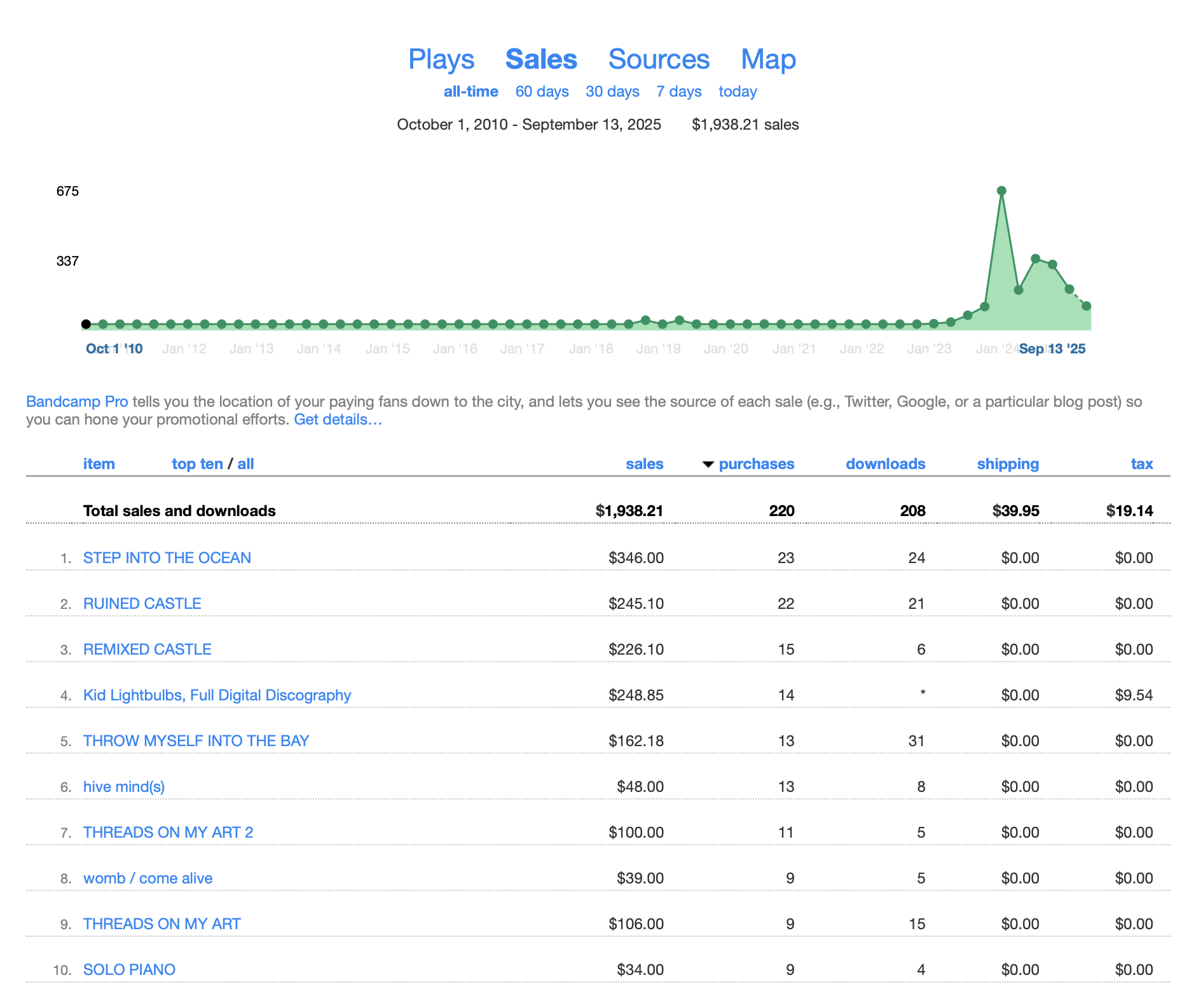
And if you treat your fans right, they return the favor. I know this because I am extremely privileged to have a few fans of my own, some of which have spent over $100 on just digital music and t-shirt merch that I’ve released. And I haven’t toured or released any physical media (yet).
This is not the same as “the customer is always right”. The customer may be wrong, and/or you may disagree with them. But you cannot blame them for being so because in most cases the reasons they are “wrong” are either (1) legitimate in their own way or (2) not the listener’s fault but due to some other systemic reason that led to this.
This all also applies to pretty much any other scenario including in business. Your customer may not always be right, but you should not blame them for being wrong.
Don’t tell me that music and TV are not in competition for one’s attention because music doesn’t require you to look at a screen. Ever do work with The Office playing in the background? Or a YouTube playlist? ↩︎
